Le Morne or Pointe d'Esny: Which Kite Lagoon Should You Choose in Mauritius?
Published on Oct 22, 2026· Updated on Oct 24, 2026· 12 min read

Contents
If you have to choose between Mauritius' two big kite lagoons, the answer depends mostly on the month and the wind direction. Le Morne is the best choice during the peak south-east trade wind season (June to October), if you want strong wind, plenty of schools and the option to move on to the reef and the waves. Pointe d'Esny suits beginners who want a wind that pushes them back to the beach, riders looking for a quiet spot, and anyone travelling from November to February: at that time of year the wind often swings to the east, which is a problem at Le Morne but still workable on the south-east coast. Heading out at the end of the year? Stay on the Mahébourg side instead, or rent a car so you can switch spots. Below we go through the wind, the water, the safety and the logistics of each lagoon.
1. The verdict in one table
Here is a summary before the details. The wind values are averages from several statistical sources (details in section 2). In Mauritius, no station is perfectly placed on the spots, so take them as trends rather than guarantees.
| Criterion | Le Morne (lagoon) | Pointe d'Esny |
|---|---|---|
| Location | South-west tip, at the foot of Le Morne Brabant | South-east coast, south of Mahébourg and Blue Bay |
| Ideal wind | South-east (seasonal trade wind) | North to south-south-east, with south-east the main direction |
| Problem direction | East-south-east to north: gusts coming off the mountain | Few blocking directions, but the water gets choppier in an easterly |
| Wind angle to the beach | Side-shore to side-off depending on where you are | Side-onshore (side-shore in south-east/south wind, onshore in an easterly) |
| Best months | June to October | June to October, and still usable in summer when the wind goes east |
| Crowds | Busy in high season | Quiet |
| Access from SSR airport | About 1 h to 1 h 15 by road | About 15 to 20 min |
| Best for | All levels in season, ideal for fast progression and access to the reef spots | Beginners, families, riders after some peace and quiet, trips from November to February |
2. The wind: direction matters as much as strength
People often talk knots, but in Mauritius it's mainly the direction that makes the difference between spots. The island has pronounced relief, and a mountain upwind doesn't just block the air: it makes it gusty and irregular.
2.1 Le Morne: excellent in a south-easter, tricky when the wind goes east
The Le Morne lagoon is made for the south-east trade wind. When it's established, from June to October, the wind hits the water unobstructed from across the lagoon, and it's steady. That's what built its reputation. The problem comes when the wind shifts. The Pointe d'Esny spot page on Kiteforum says it clearly: the Le Morne lagoon works poorly as soon as the wind goes from east-south-east round to north, because the air comes down off the relief in gusts. In that case you'll get holes in the wind, sharp gusts and a kite that drops out of the sky at the wrong moment. Not ideal for progressing.
In practice, check the forecast direction the day before. A solid south-easter is the signal to head to Le Morne. An east or east-north-east wind often means a day on the east or south-east coast instead. Before hitting the road, check the real-time wind on our live wind and webcams for Le Morne page.
2.2 Pointe d'Esny: a beach open to a wide range of directions
Pointe d'Esny has the advantage of working across a much wider range of wind directions. Again according to Kiteforum, the spot accepts any wind between north and south-south-east, with south-east the dominant direction. The angle changes the way you ride:
- South-east or south wind: the wind is side-shore, which is the best setup according to Kitetrip Planner.
- East wind: it still works, but it becomes more onshore and you end up riding more along the beach.
For a beginner, a side-onshore wind is reassuring: if something goes wrong, it brings you back to shore instead of taking you out to sea. Kitecorner describes it as a forgiving wind. It also points out that it blows mostly from the south-east and tends to go east in the heart of summer.
2.3 November-December: what the stats show
It's the end of October and many of you are planning a trip for the year-end holidays. This is precisely the period when the difference between the two lagoons is sharpest. Here is the monthly data available for Pointe d'Esny, from two different sources:
| Month | Rideable wind probability (Kitetrip Planner) | Average wind on windy days (Kite Jungle) | Average direction (Kite Jungle) |
|---|---|---|---|
| June | 86% | 14 kts | SSE |
| July | 83% | 15 kts | SSE |
| August | 80% | 15 kts | ESE |
| September | 80% | 14 kts | ESE |
| October | 70% | 13 kts | SSE |
| November | 54% | 11 kts | E |
| December | 64% | 11 kts | E |
| January | 60% | 12 kts | E |
Three things to take away:
- The wind drops noticeably after October. On Kitetrip Planner, it goes from 86% in June to 54% in November. In November-December, expect roughly one day in two or three without rideable wind. Plan some activities for those days.
- The average direction swings to the east from November to February on Kite Jungle, and Kitecorner even gives east-north-east in December. That's exactly the sector that makes Le Morne gusty.
- The sources don't agree on wind strength. Kitecorner, which averages every hour including when there's no wind, only finds 7 to 10 knots on average. Kite Jungle only counts days at 12 knots and above. Both figures are right, they just don't measure the same thing. For your forecasts, rely on the models and the day's observations, not on yearly averages.
What it means for your kit: at the end of the year, it's big-kite season. Our spot page recommends 9 to 13 m² at Pointe d'Esny. Between November and January, a 12 or 13 m² and a slightly bigger board (or a foil) will often make the difference. For your weight, use the kite size calculator. If you're travelling in the heart of summer, also read our article on kiting during cyclone season.
3. The water: two lagoons, two personalities
3.1 Le Morne: flat water, crowds and reef access
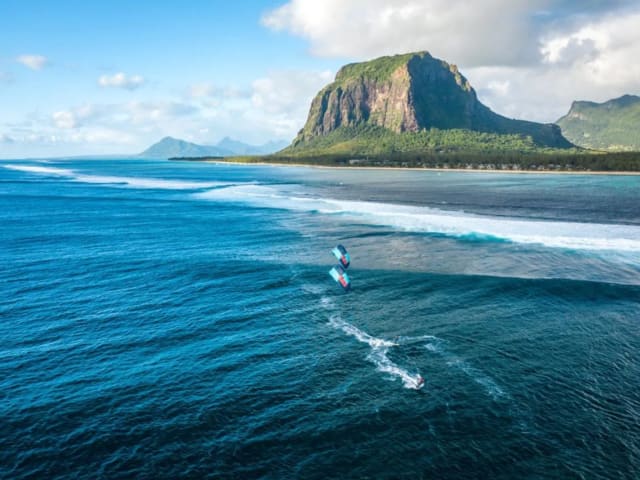
The Le Morne lagoon is big, shallow in places and flat when the trade wind blows from the south-east. It's an ideal playground for stringing together runs, learning jumps or moving into freestyle. Its big advantage is what surrounds it: from the same area, experienced riders can reach outer spots like Manawa or the One Eye reef wave, often by boat with a school or a centre. Once you're comfortable in the lagoon, you can progress to the waves without changing base.
The flip side is the crowds. In peak season, on a good wind day, the lagoon is the busiest on the island: schools, students, independent riders, not to mention other lagoon users. Respect right-of-way rules and leave room for the lesson zones. The wind is side-shore to side-off depending on where you are on the beach, so if your kite drops out, the drift won't necessarily bring you back to shore. That's why schools work with boat assistance.
3.2 Pointe d'Esny: clear, calm, but with a few traps
Kiteforum presents Pointe d'Esny as probably the biggest lagoon on the island, with very clear water. The water isn't uniform:
- In the south, the water is fairly flat, making it the best area to learn.
- Heading north, it gets choppier, especially near the big channels.
- Between the coast and Île aux Aigrettes, Kiteforum flags a strong current running in the same direction as the wind, which makes going upwind noticeably harder.
- Behind the islets, Kitetrip Planner warns of sheltered zones where the wind suddenly drops. Don't go too far left (towards Île aux Aigrettes), because you risk ending up in no wind, a long way from the beach.
- Moored boats in front of the beach: this is the main drawback cited by the same source, along with access to the spot that isn't always easy to find the first time. On the plus side, there's a wreck to discover in the lagoon.
There is a wave at the south end of the lagoon, but Kiteforum points out that it's sheltered from the wind and not suitable for kiting. Pointe d'Esny is therefore a lagoon spot, full stop. If you're after waves, Le Morne is where to go.
4. Level and safety: which is better for learning?
For a very first course, we lean towards Pointe d'Esny, based on three concrete criteria:
- Wind angle. A side-onshore wind brings you back to the beach. At Le Morne it's side-shore to side-off depending on where you are, which calls for closer supervision.
- Crowds. Fewer people means less risk of tangled lines and more room to botch a waterstart without getting in anyone's way. Our spot page rates Pointe d'Esny as quiet.
- Stress. Learning on calm, open water really does help you progress faster.
Careful though, Pointe d'Esny isn't risk-free. The current towards Île aux Aigrettes and the no-wind zones behind the islets can trap a beginner riding alone. Breeza notes that the local school works from boats. Until you're independent, take supervised lessons with on-water assistance.
At Le Morne, a beginner guided by a good school will also learn very well, and plenty of kiters have done their first runs there. The difference is that riding on your own, you need a bit more skill to feel comfortable: being able to ride upwind, handling a kite relaunch in the middle of a crowd and knowing the right-of-way rules. To choose your school, use our school comparison tool, which covers both areas.
5. Logistics: access, accommodation, vibe
| Practical point | Le Morne | Pointe d'Esny |
|---|---|---|
| Arriving by plane | About 1 h to 1 h 15 by road from the airport, more depending on traffic | 15 to 20 min from the airport: the closest spot according to Kitecorner |
| Accommodation | Hotels on the peninsula, villas and apartments in nearby villages, plenty of kite-oriented options | Villas, guesthouses and apartments around Pointe d'Esny, Blue Bay and Mahébourg |
| Vibe | A kiter village in season, lots of riders, centres and services | More residential and local, few kiters |
| Nearby spots | Manawa, One Eye, Ti Reef, and further along the south coast | Blue Bay, and the east coast heading north |
| Combining the two | About an hour's drive along the south coast between the two areas. Doable on a fallback day, but not every day. | |
Being close to the airport matters more than you'd think. If you land in the morning, you can be on the water in the afternoon at Pointe d'Esny.
6. Which lagoon for which rider?
- First course, June to October: both work. Pick Pointe d'Esny for the calm and side-onshore wind, or Le Morne for the choice of schools and the vibe.
- First course, November to February: Pointe d'Esny. The wind is lighter and often easterly, and Le Morne gets gusty in that setup.
- Intermediate looking to progress (jumps, transitions): Le Morne in season, for the steady wind and flat water. Keep Pointe d'Esny as your fallback spot on easterly days.
- Advanced rider who wants waves: Le Morne, no question, for access to the reef spots. Pointe d'Esny has no rideable wave.
- Couple or family with non-kiters: Pointe d'Esny-Blue Bay, for short transfers and activities close by.
- Foilers: both lagoons work. In light summer wind, Pointe d'Esny stays usable and quiet. Watch out for moored boats and shallow areas.
- Trip of 10 days or more: rent a car, choose a base according to the season and go chase the right wind direction each day.
7. FAQ
Can you kite at Le Morne in December?
Yes, on some days. When the trade wind stays south-easterly, the lagoon works well. But in December the average direction often goes east, even east-north-east, and in that sector the wind reaches Le Morne in gusts after passing over the relief. Look at the forecast direction the day before rather than strength alone.
Is Pointe d'Esny a good spot for a beginner riding alone?
Not until you're independent. The side-onshore wind helps, but the current between the coast and Île aux Aigrettes and the no-wind zones behind the islets can trap a beginner. Stay in the southern part of the lagoon, where the water is flattest, and ride with a school until you can go upwind without difficulty.
What kite size should I bring for Pointe d'Esny at the end of the year?
Our spot page gives a range of 9 to 13 m². From November to January, the average wind on windy days is around 11-12 knots according to Kite Jungle. For a 70-80 kg rider, a 12-13 m² will often be the kite of the day. A bigger board or a foil lets you extend your sessions.
Which of the two lagoons is busier?
Le Morne, by a long way. It's the island's main kite hub, with the highest concentration of schools and riders. Pointe d'Esny is rated as quiet. The main obstacle there is rather the moored boats in front of the beach.
Can you ride both spots in the same trip?
Yes, with a car. Allow about an hour's drive along the south coast. The most efficient strategy: one main base chosen according to the season, and the other spot when the wind direction suits it.
8. Conclusion
Le Morne and Pointe d'Esny aren't really rivals: they complement each other. Le Morne is the best choice in a south-easter, from June to October, to progress fast, enjoy a real kite scene and get out to the reef. Pointe d'Esny is the calm lagoon of the south-east, close to the airport, suited to beginners thanks to the side-onshore wind, and able to deliver when the wind goes east. That's exactly what happens most often from November to February. For a trip this year-end, come with big kites and realistic expectations: roughly one day in two to two in three with rideable wind according to the stats. Pick your base on the south-east side, and look at wind direction before strength. For the details on each spot, check out our Le Morne kite lagoon and La Pointe d'Esny pages.
Sources
- Kiteforum – Pointe d'Esny, Mauritius (spot page: directions, current, Le Morne in an easterly)
- Kitetrip Planner – Kitesurf at Pointe d'Esny (monthly probabilities, wind-shadow zones, moored boats)
- Kite Jungle – Pointe d'Esny (average wind and direction by month)
- Kitecorner – Pointe d'Esny (monthly statistics, distance to the airport)
- Breeza – Kitesurfing Pointe d'Esny
- Windfinder – Wind statistics Pointe d'Esny / Grand Port