Kitesurfing for Kids and Teens in Mauritius: Minimum Age, and How to Plan a Family Kite Trip
Published on Nov 16, 2026· Updated on Nov 20, 2026· 11 min read
Contents
At most schools, a child can start kitesurfing around age 12. Some will take kids from 8-10 years old in private lessons, provided they weigh at least 30 to 40 kg depending on the school and can swim. In Mauritius, the shallow lagoons at Le Morne, Pointe d'Esny and Anse La Raie suit young beginners well. For the December-January holidays, be aware that the wind is less consistent, the heat is strong and it's cyclone season. So book more days than lesson hours, choose short private lessons and ask the school the right questions before you pay.
1. How old does a child need to be to learn kiteboarding?
There is no single legal age, and each school sets its own rules. In practice, two criteria matter: age, and above all weight. A kite pulls with a force that depends on its size and the wind, not on the rider's age. A child who is too light can be lifted or dragged even with a small kite in a gust.
1.1 What schools actually do
The minimums schools advertise vary, but they overlap quite well:
| Source | Stated minimum age | Stated minimum weight | Format |
|---|---|---|---|
| General guide (Sport Découverte) | 12-14 years | around 45 kg | Swimming certificate required, groups of 6 children maximum |
| French school (Tiki Center) | 8-10 years | 35 kg | Private lessons up to age 14, group lessons beyond that |
| IKO school (Kitemed) | over 12 years | 35 kg | Kids' lessons following the IKO syllabus |
| IKO schools (Hurghada) | 12 years, sometimes 8-10 | 35-40 kg | Parental consent for certification |
| IKO school (Essaouira) | no fixed age | 30 kg | Weight matters more than age |
The takeaway: 12 is the norm, 8-10 is possible case by case, and below 30-35 kg almost every school will say no. Some Brazilian schools say they take kids from 7-8 years old. That's the exception, and it requires very suitable gear and a very suitable spot.
1.2 Why weight comes before age
For an adult, you match kite size to body weight and wind. For a child, the margin is much narrower. If your 11-year-old weighs 32 kg, you need a very small kite and steady wind. Gusts are far less forgiving at that weight. On the other hand, a 13-year-old teen weighing 50 kg can take an almost normal lesson. Two kids of the same age can have very different builds, and a good school will look at the scale before the date of birth.
1.3 Non-negotiable prerequisites
- Being able to swim, and being comfortable with their head underwater. The harness and the bar don't change the fact that you fall, a lot.
- Being able to listen to an instruction and apply it right away, even when the kite is pulling: letting go of the bar, firing the quick release. It's often maturity, more than strength, that sets the real starting age.
- Actually wanting to do it. A kid who kites just to please their parents gives up at the first failed body drag. Better to find out before paying for a course they'll just endure.
- No medical contraindications. If in doubt (asthma, heart condition, epilepsy), talk to a doctor before you leave.
2. Which lesson format to choose for a child or teen
2.1 Private or group lessons?
Before about age 14, go for private lessons, one instructor for one child. Several schools require this anyway. In a group, the child either shares a kite sized for an adult or waits their turn on the beach in the sun. Both are bad for them. From 14-15, with an adult build, a teen can join a group lesson, or even the same lesson as a parent. That's often the best memory of the trip.
2.2 Shorter sessions
An adult can easily string together 2 to 3 hours of lessons. A 10-year-old tires and gets cold faster, and their concentration drops quickly. Ask for slots of one to one and a half hours spread over several days. The total volume stays roughly the same as for an adult. Expect 6 to 12 hours for a full introduction, and generally 8 to 10 hours of kite flying before the first waterstarts. To ride independently, you need around 12 hours of lessons, if the wind cooperates. For a child, treat those numbers as a minimum, not a promise.
2.3 Starting with a trainer kite
Is your child too young or too light for a real lesson? Some schools suggest starting with a trainer kite on the beach. They learn the wind window, power and kite-flying reflexes, without a harness or board. It's cheap and safe, and very effective. They'll be much more comfortable at their first real lesson a year or two later.
2.4 IKO certification for a minor
IKO programs are open to minors, with parental consent. Once the course is finished, the child receives their level card, just like an adult. It will be useful later for renting gear or taking lessons elsewhere in the world. Also note that a certified IKO instructor must be at least 18. If someone offers you an "instructor" who looks very young, ask about their status.
3. Which spots in Mauritius for a child
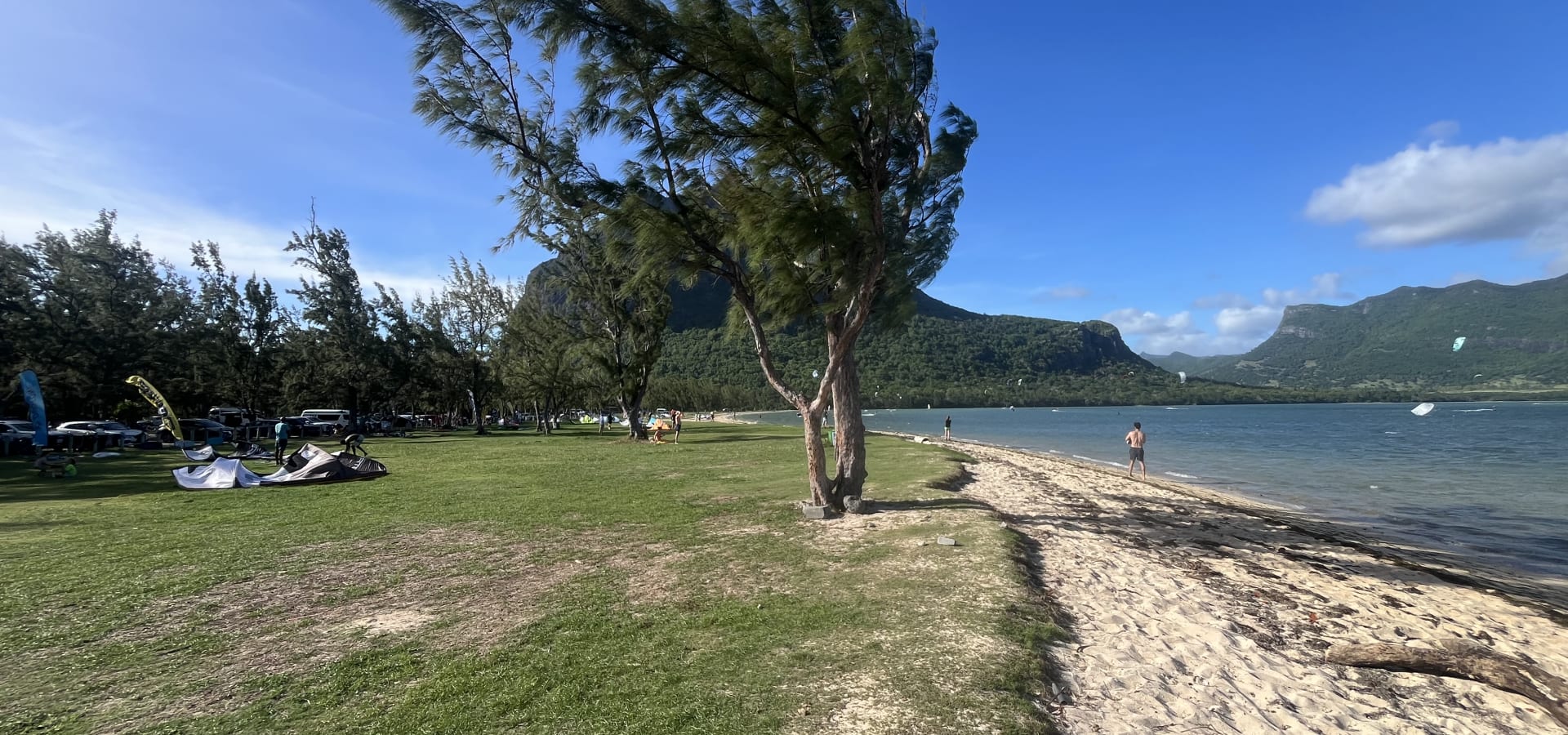
For a child, a good spot combines three things: water where they can stand, a bottom free of hazards and room downwind before any obstacle. Mauritius has several. It also has reef spots that no beginner child should go anywhere near.
| Spot | For a beginner child? | What to know |
|---|---|---|
| Le Morne kite lagoon | Yes, with a school | Big lagoon with large stand-up areas, and lots of schools. The spot is busy, so you need an instructor who keeps the child away from traffic. |
| Pointe d'Esny | Yes | Turquoise, shallow lagoon in the southeast, calmer than Le Morne. Keep an eye on the tide and the coral. |
| Anse La Raie | Yes | Flat lagoon in the north behind the reef. An option if you're staying in the north. |
| One Eye, Manawa, Ti Reef (Le Morne) | No | Reef waves for experienced riders. Watch from the lagoon, nothing more. |
| Poste Lafayette | No | Wild, exposed spot, without the protection of a shallow lagoon for learning. |
Le Morne and Pointe d'Esny are the island's two big learning lagoons. Since they're at opposite ends of the south, choose your accommodation based on the spot where your child will take lessons. You'll save yourself an hour's drive with a tired kid.
4. Year-end holidays: how the season changes a kids' kite trip
Many families come for Christmas or New Year. It's the southern summer, and for a child the conditions differ from winter, which is the main trade wind season.
4.1 Less consistent wind
In December-January, the trade winds are generally less established than in winter, and there are more days with no wind or light wind. For a light child, moderate wind isn't necessarily a problem. The real issue is unsteady wind with gusts. So plan a trip longer than the number of lesson hours. For 6 hours of lessons, allow at least 7 to 10 days on site, and don't book the whole course on fixed dates. For more details, see our article Kitesurfing in Mauritius in November and December.
4.2 Heat and UV: kids are more exposed
During a lesson you spend hours on the water with no shade, and the sun reflects off the lagoon. A child dehydrates and burns faster than an adult, and doesn't always say when they're too hot. They need a long-sleeve rash guard, water between sessions and a proper hat on the beach. Avoid scheduling a child's lessons in the hottest hours when possible. All our recommendations are in Sun, UV and heat when kiting in Mauritius.
4.3 Cyclone season
The southern summer is also cyclone season. If a system approaches, schools close and the sea stays rough for a few days. So keep a few buffer days and check that your travel insurance covers cancellation due to weather.
5. Organizing the family trip
5.1 Choosing the school: questions to ask
Before booking, write to two or three schools. You'll find the island's schools on our Compare schools page. Then ask these questions and compare the answers:
- What minimum age and weight do you accept? Don't settle for a "no problem" without them even asking your child's weight.
- Do you have kite and harness sizes for kids? An oversized adult harness can ride up under the arms, and that's dangerous.
- Is the lesson private? Where does the instructor stand? In the water next to the child, on a boat, or from a distance with a radio helmet?
- What's the policy if the wind is too strong or too light? Is the lesson rescheduled or refunded?
- Is the instructor certified, and will the child receive a level card?
- Do you provide a helmet and an impact vest? For a child, ask for both.
5.2 Personal gear to bring
- A long-sleeve rash guard, or a thin shorty if the child gets cold staying in the water for a long time.
- Reef shoes: you walk a lot in the water during a lesson, and the bottom can hide coral, sea urchins or a stonefish. See our article Stonefish in Mauritius: what's the real risk?
- Water-resistant sunscreen, a water bottle and a hat for breaks.
- The helmet, vest and harness normally come from the school. Check that they fit properly.
5.3 Budget
A private lesson costs more per hour than a group one, and it's the recommended format for a child. Since the sessions are shorter, the final bill stays about the same as an adult's private course. Prices at Mauritian schools vary from school to school and season to season. Ask for a written quote that states the number of hours and the cancellation policy for wind.
5.4 What about the rest of the family?
The learning lagoons are also good for snorkeling, swimming and paddleboarding, and non-kiting parents won't get bored there. If one of the parents already kites, they'll want to ride during the child's lesson. Avoid it, at least for the first few sessions. A parent watching from the beach reassures the child, and they're the one who'll be called if something goes wrong.
6. Safety: points you shouldn't compromise on
- Never alone, and never on an adult's gear. Even a child who has already done a course shouldn't borrow Dad's kite "just to try."
- No sessions in strong gusts. What doesn't bother a 75 kg adult can lift a 35 kg child. If the instructor says no, it's no.
- Always in shallow water, and upwind of obstacles. You need room downwind: no reef, no moored boats, no crowded beach.
- Review the safety moves every session: letting go of the bar, firing the quick release, doing a simple self-rescue. A child forgets quickly from one day to the next.
- Stop before you're exhausted. Most incidents happen at the end of a session, when people get tired.
7. FAQ: kids' kitesurfing in Mauritius
My child is 9. Can they take kitesurfing lessons in Mauritius?
It's possible, but not everywhere. You need a private lesson and a weight of at least 30 to 35 kg, depending on the school. You also need moderate, steady wind, and the school must have gear in their size. If the school hesitates or has no suitable gear, start with a trainer kite.
What minimum weight do you need to kitesurf?
Schools generally state between 30 and 45 kg. Below 30-35 kg, almost all of them refuse water lessons. From around 45 kg, a teen can take a lesson close to an adult's.
Can a parent and a teen take the same lesson?
Yes, if the teen has a build close to an adult's, from around 14-15 years old. The simplest option is a duo lesson, with one instructor for two students of similar level. For a younger child, book two separate private lessons at the same time.
Is December a good time for a kids' kite course in Mauritius?
Yes, but you need to build in some margin. The wind is less consistent than in winter, it's hot and it's cyclone season. With 7 to 10 days on site for about 6 hours of lessons, you'll do fine in most cases.
Will my child get a certification?
If the school follows a program like IKO, yes. Minors can be certified with parental consent, and the level card is recognized at other schools in the network.
8. Conclusion
For a child, what matters is weight, maturity and a lagoon where they can stand, much more than age. In Mauritius, Le Morne, Pointe d'Esny and Anse La Raie offer those conditions, as long as you choose a school that genuinely has gear and a method for kids. For year-end holidays, take short private lessons, keep buffer days for wind and weather, and protect your child from the sun. If they're not quite ready, a trainer kite this year will prepare them for a real course later. To get started, compare the schools and send them the list of questions above.
Sources
- Sport Découverte – À partir de quel âge peut-on pratiquer le kitesurf ?
- Tiki Center – Cours de kitesurf enfants & ados
- MF Kite – Quel âge pour commencer le kitesurf ?
- Kitemed – Kitesurfing lesson for kids
- Masters Surf School – Hurghada kitesurfing requirements (IKO)
- Essaouira Kite Paradise – Kitesurf lessons and rental
- Kite Club Icaraizinho – How long does it take to learn kitesurfing?
- C2i Révision – Initiation kitesurf


