Stonefish in Mauritius: What's the Real Risk in the Lagoon?
Published on Jul 7, 2026· 10 min read
Contents
Are there stonefish in the lagoons of Mauritius, and what risk do you really take walking barefoot in the water? Direct answer: yes, the stonefish lives in Mauritian lagoons — and while stings remain rare, they rank among the most painful in the marine world. Good news: with two simple reflexes (booties and the right way to walk) and a first-aid protocol known in advance, this risk is very manageable. This guide covers the topic thoroughly, backed by medical data — because if there's anyone walking through the lagoon all day long, it's the kitesurfer.
1. The stonefish in two minutes
| Species | Synanceia verrucosa — "laffe la boue" in Mauritian Creole |
| Reputation | One of the most venomous fish in the world |
| Weaponry | About 13 dorsal spines connected to venom glands |
| Size | 30 to 40 cm, shapeless brownish mass |
| Where | Sandy bottoms, reef flats, around coral heads, from 0 to 30 m |
| Behaviour | Completely motionless, camouflaged as a rock — it does not flee when you approach |
| Danger | Only if you step on it: it never "attacks" |
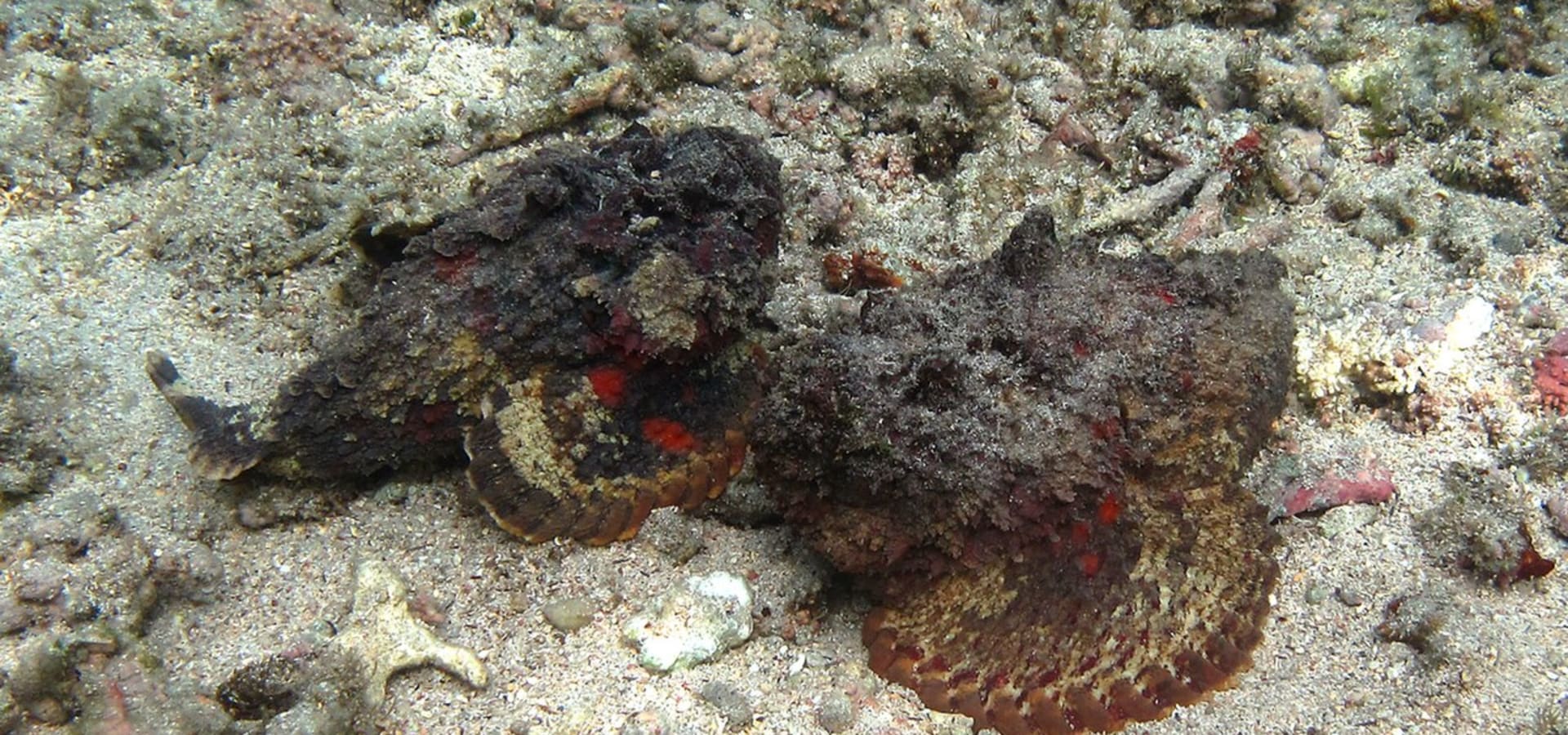
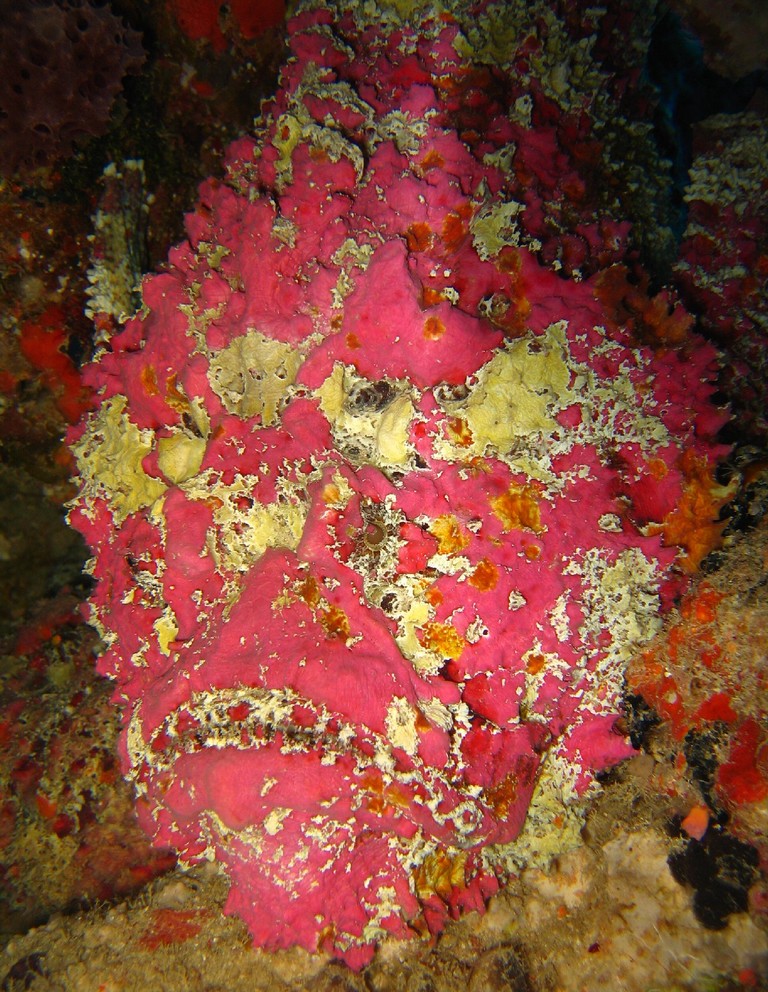
The key point to understand: the stonefish is not aggressive. It's an ambush hunter that relies on its camouflage — a camouflage so effective that it looks exactly like an algae-covered stone. That's where the danger comes from: you don't see it, so you step on it, and its dorsal spines rise and inject venom under the pressure of your foot.

2. Are there really any in Mauritian lagoons?
Yes. The stonefish lives throughout the tropical Indo-Pacific, from the Red Sea to Polynesia, including the Mascarene Islands — and Mauritians have always known it by its Creole name "laffe la boue". The local press regularly documents stings: one notable episode saw five swimmers stung within a few days in the northern lagoons (Trou-aux-Biches, Mont-Choisy) and at Albion — locals and tourists alike, all treated, no deaths. Sightings are also reported at Blue Bay and on other shallow reef flats.
Where exactly does it lie in wait? Precisely where we like to walk:
- the sandy and muddy bottoms of calm lagoons, where it partially buries itself;
- around coral heads and debris, where its camouflage is perfect;
- the reef flats exposed at low tide, in a few centimetres of water;
- shallow, sheltered areas — the very ones where you learn to kite.
3. The risk in honest figures
This is where this guide sets itself apart from the scaremongering accounts: let's look at the real data.
- In Mauritius, there is no public hospital tally of stings. The cases documented by the press number a handful per year, and no stonefish death is documented there from any verifiable source.
- In neighbouring Réunion — same species, same lagoons, and published medical data: a study of 135 envenomations recorded between 2020 and 2024 concludes at around 30 stings per year… and zero deaths, neither over the study period nor in the ten preceding years. A telling detail: 95% of stings affect the foot, and tourists account for only a quarter of the cases.
- In Australia, an area with a strong presence of the species, there are fewer than 50 serious cases per year, and the Australian Museum records no confirmed death since the arrival of Europeans. On a global scale, the literature documents only very rare fatal cases (1915, 2010).
- To put things in perspective: the most common marine injuries in the lagoons are — by far — coral cuts, sea urchins and jellyfish. And the real statistical danger of swimming in Mauritius remains drowning, on a scale incomparable to wildlife.
Translation for the kiter: the stonefish is a real risk but low in frequency, almost nil in mortality with proper treatment — and almost entirely avoidable with the right reflexes. It deserves respect, not panic.
4. Why kiters are on the front line
Do the math on a typical session in the lagoon at Le Morne or Anse la Raie: you walk to carry your gear to the water, you shuffle around during the kite launch, you set your foot down at every failed water start, you cross the reef flat on foot at low tide to get back. A beginner in a lesson literally spends hours standing in 50 cm of water — exactly the depth and type of bottom the stonefish frequents.
Add two aggravating circumstances specific to kiting:
- low tide, the moment when you cross the shallowest areas and when stonefish get trapped in the pools of the reef flats;
- your attention elsewhere: when you're managing a 12 m² kite above your head, you're not looking where you put your feet.
That's why this guide exists: not to dissuade you from kiting in Mauritius (the lagoon remains one of the safest playgrounds in the world — far safer on the shark side than you'd imagine), but so that anti-stonefish gear becomes as automatic as your safety leash.
5. The sting: what really happens
Stonefish venom is a cocktail of proteins (stonustoxin, verrucotoxin) with cardiovascular and tissue effects. In practical terms, a sting causes:
- Immediate and extreme pain — in the Réunion study, three out of four victims rate it between 8 and 10 out of 10. It radiates from the foot toward the base of the limb and peaks within one to two hours.
- Marked swelling that can spread through the entire limb within minutes, sometimes followed by a bluish halo around the wound.
- Rarely, general symptoms: nausea, sweating, malaise, cardiac rhythm disturbances — severe forms (extensive necrosis, pulmonary edema) exist in the medical literature but remain exceptional.
- Recovery in days to weeks depending on the depth of the sting, with tingling that may persist.
One characteristic of the venom changes everything for first aid: it is thermolabile — heat breaks it down. This is the basis of treatment.
6. The first actions that change everything
Memorize this sequence before your next trip — it's the most important passage in this article:
- Get out of the water immediately and sit down: the pain can make you faint, and passing out in the water is the truly dangerous scenario.
- Immerse the foot in hot water — 42 to 45 °C, never more — for 30 to 90 minutes. The heat neutralizes the venom and dramatically relieves the pain. Warning: no boiling water — the stung limb loses its sensitivity and burns without you feeling it. The test: the water must be bearable for your other foot.
- Remove anything visible (a spine fragment at the surface) but never dig into the wound; no tourniquet, no incision, no suction — these "remedies" make everything worse.
- Head to a public hospital right away, even if the pain subsides: the wound must be explored (spine fragments), tetanus checked, and serious forms monitored. In Mauritius, call the SAMU at 114 (or 999). Choose the hospital over a small clinic: that's where the envenomation protocols are — an antivenom exists (made in Australia) and severe forms may warrant it.
- In the following days, watch for infection (spreading redness, fever): marine wounds get infected easily and are treated well if you seek care early.
On the spot, the smart reflex: kite schools are used to this — they warn you, help, know the nearest hospital. Report any sting to the nearest center, even if you're self-reliant.
7. Prevention that actually works
- Thick-soled booties, all the time. This is THE number one measure — but let's be honest, as always on this site: stonefish spines can pierce a thin beach bootie sole. A rigid, thick sole greatly reduces the risk without eliminating it 100%. Good news: in Mauritian lagoons, booties are essential anyway against coral and sea urchins.
- Shuffle your feet instead of walking (the "shuffle" technique, recommended by Australian authorities): by sliding your feet along the bottom, you push the animal aside instead of stepping on it — the same move also protects against rays.
- Look before you step: near coral heads and debris zones, every "rock" deserves a glance. When in doubt, go around.
- Maximum vigilance at low tide on the reef flats — and keep it in mind too when setting down your kite or board in shallow water.
- Teach the word "laffe" to the children who accompany you: booties on, no running in reef-flat puddles, no picking up "pretty rocks" underwater.
8. The lagoon's other stingers (quick overview)
- Sea urchins — by far the most common injury for Mauritian kiters: painful, rarely serious, same booties, tweezers and a consultation if fragments are deep.
- Scorpionfish and lionfish (pterois) — cousins of the stonefish, more visible, less potent venom: same hot-water treatment.
- Stingrays — resting on the sand; the "shuffle" makes them flee before contact.
- Cone snails — the real trap for shell collectors: some live cone snails are dangerously venomous (the only well-documented marine envenomation death in Mauritius, in 1985, was due to a cone snail, not a stonefish). Simple rule: never pick up any live shell.
- Coral — not venomous, but sharp and slow to heal: systematically disinfect any scrape.
9. Stonefish FAQ in Mauritius
Are booties enough to protect me?
They eliminate most of the risk — the vast majority of stings occur barefoot or in flip-flops — but a spine can pierce a sole that's too thin under body weight. Choose booties with a thick, rigid sole, and combine them with the shuffle walk: the two together make a sting highly unlikely.
Can you spot a stonefish with the naked eye?
Rarely: its camouflage is considered one of the best in the marine world. Don't rely on your eyes — rely on your soles and the way you walk. This is precisely what sets it apart from scorpionfish, which are much more visible.
What should I do if I'm stung far from everything, on the wild lagoon side?
The protocol doesn't change: get out of the water, hot water at 42-45 °C as soon as possible (a thermos from the car, guesthouse, nearest kite school), and head to the public hospital — call 114 on the way. The pain is intense but time is on your side: deaths are exceptionally rare, even far from help.
Is it fatal for a child?
Réunion and Australian data record no child deaths; small body size, however, increases the relative intensity of envenomation — same rules, with more rigor: booties always, supervised zones, hospital without delay in case of a sting.
Should I avoid certain kite spots because of laffes?
No — no Mauritian spot is "infested," and cases are spread across all the island's shallow lagoons. The risk comes from behavior (barefoot, walking blind), not the spot. Equipped with booties, you can kite anywhere, from Le Morne to Poste Lafayette.
Is the stonefish really "the most venomous in the world"?
It is regularly described that way, and it is certainly among the most venomous fish known. But the real question isn't the superlative: it's that with hot water, a hospital and two prevention reflexes, this venom champion causes far less damage each year than the reef-flat sea urchins.
10. Conclusion: respect, not panic
The stonefish is part of the Mauritian lagoon just as much as the turtles and giant clams — it was here before us and doesn't attack anyone. The figures are clear: a few stings per year, a memorable pain, near-zero mortality with the right actions. The kiter's response comes down to three lines: thick-soled booties in the bag (on par with the harness), the shuffle-walk in shallow areas, and the memorized hot water + 114 protocol. After that, all that's left is to enjoy the most beautiful office in the world — starting with our Le Morne guide and the travel checklist (the booties are already on it).
Main sources: FishBase — Synanceia verrucosa; StatPearls/NCBI — Stonefish envenomation; Int. J. Emergency Medicine 2025 — series of 135 cases in Réunion; Australian Museum; Mauritian Ministry of Health (SAMU 114); Le Mauricien (local cases). This article is informative but does not replace medical advice.
Sources
Photo: Elisabeth Morcel / Wikimedia Commons, CC BY-SA 3.0